I've seen both Blade movies now. The premise is that there are now two humanoid races in the world; humans and vampires. The vampires prey on the humans, and if a human gets bitten by a vampire, s/he becomes a vampire, if they don't die outright. Kind of an interspecies one-drop rule. Once you try Drac, you can never go back.
Vampires can only be out at night; they can't stand the bright light of day. But Blade is different. He's the son of a black mother who was bitten by a white vampire while she was pregnant. Blade's a vampire-human mulatto. Unlike a full blood (!) vampire, he can tolerate the both daylight and night. The vampires call him Day-Walker. Blade hates vampires and is trying to kill them all, and to destroy the vampire side of himself. He spends a lot of time trying to discover a serum that will suppress the vampire in him. He has to take the serum regularly, or the vampire side of him starts to break through. In the first film, "vampire" gets coded as "black" and "human" as "white." The film makes explicit jokes about Blade being an Uncle Tom; it's right there in the dialogue. The serum is administered intravenously, and Blade goes through a total junkie enactment when he self-administers the serum; ties a vein up, injects himself, has a bit of a fit, trembles and shakes, nods off for awhile. Made even more interesting by the fact that he's played by a black man, the junkie imagery being a popular way of portraying black men in film and television.
Entire Article
Sunday, January 19, 2014

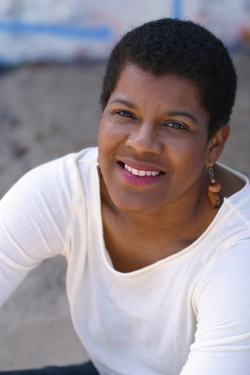
Tananarive Due
Speculative and Creative Fiction Writer
Tananarive Due
Official Site
Artist Info Pages
Published Works
African Immortals Series
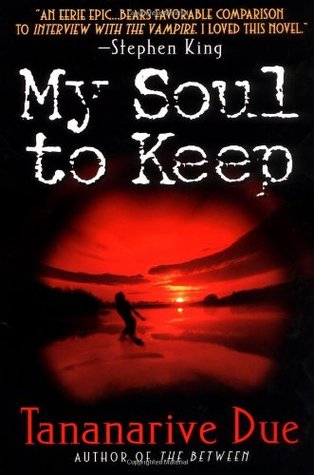
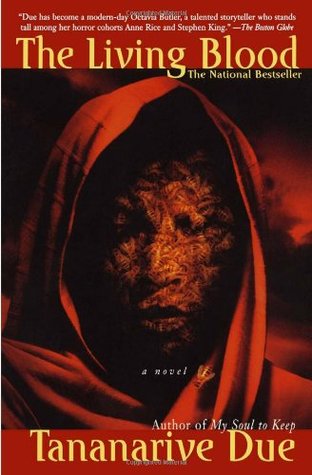
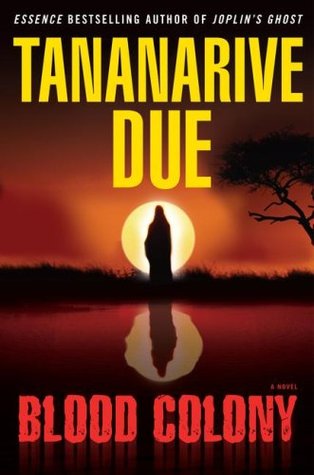
Speculative FIction Novels
The Between

The Good House

Joplin's Ghost

The Between
When Hilton was just a boy, his aged grandmother saved him from drowning by pulling him out of a treacherous ocean current, sacrificing her life for his. Now, thirty years later, Hilton begins to think his borrowed time is running out. His wife, the only elected African–American judge in Dade County, Florida, has begun receiving racist hate mail from a man she once prosecuted, and Hilton's sleep is plagued by nightmares more horrible than any he has ever experienced.
As he battles both the psychotic stalking of his family and the unseen enemy that haunts his sleep, Hilton's sense of reality is slipping away. Shocking and utterly convincing, The Between is a novel about a man desperately trying to hold on to the people and life he loves but may have already lost, and it holds readers suspended between the real and the surreal until the final moment of chilling resolution.(less)
As he battles both the psychotic stalking of his family and the unseen enemy that haunts his sleep, Hilton's sense of reality is slipping away. Shocking and utterly convincing, The Between is a novel about a man desperately trying to hold on to the people and life he loves but may have already lost, and it holds readers suspended between the real and the surreal until the final moment of chilling resolution.(less)
The Good House
The house Angela Toussaint's late grandmother owned is so beloved that townspeople in Sacajawea, Washington, call it the Good House. But is it? Angela hoped her grandmother's famous "healing magic" could save her failing marriage while she and her family lived in the old house the summer of 2001. Instead, an unexpected tragedy ripped Angela's family apart.
Now, two years later, Angela is moving past her grief and taking control of her life as a talent agent in Los Angeles, and she is finally ready to revisit the rural house she loved so much as a child. Back in Sacajawea, Angela realizes she hasn't been the only one to suffer a shocking loss. Since she left, there have been more senseless tragedies, and Angela wonders if they are related somehow. Could the events be linked to a terrifying entity Angela's grandmother battled in 1929? Did her teenage son, Corey, reawaken something that should have been left sleeping?
With the help of Myles Fisher, her high school boyfriend, and clues from beyond the grave, Angela races to solve a deadly puzzle that has followed her family for generations. She must summon her own hidden gifts to face the timeless adversary stalking her in her grandmother's house -- and in the Washington woods.
Joplin's Ghost
When Phoenix Smalls was ten, she nearly died at her parents' jazz club when she was crushed by a turn-of-the-century piano. Now twenty-four, Phoenix is launching a career as an R & B singer. She's living out her dreams and seems destined for fame and fortune. But a chance visit to a historical site in St. Louis ignites a series of bizarre, erotic encounters with a spirit who may be the King of Ragtime, Scott Joplin.
The sound of Scott Joplin is strange enough to the ears of the hip-hop generation. But the idea that these antique sounds are being channeled through Phoenix? Her life is suddenly hanging in the balance. How will she find her true voice and calling? Can the power of her own inner song give Phoenix the strength to fight to live out her own future? Or will she be forever trapped in Scott Joplin's doomed, tragic past? Stunningly original, Joplin's Ghost is a novel filled with art and intrigue -- and is sure to bring music to readers' ears.
Tuesday, July 16, 2013
Racism in Fantasy & Its Effects on People of Color" By Aarti Chapati
How many people of color do you see at fantasy conventions? At sci fi conventions? How many authors of color do you know that write in the genre? How many epic fantasy novels take place in a non-quasi-feudal-Europe setting? Very, very few.
Entire Article
Entire Article
Lethal Lottery (Trayvon 2.0) - Written by Nicole Sconiers
***Speculative Fiction (Sci-Fi) version of Trayvon Martin's death
It was a deadly time to be 18, black and male. All across the country, these young outlaws were being killed. They yanked them from their cars and lynched them in Texas, stormed their homes and gassed them in Philadelphia and lay in wait for them outside of barber shops in Chicago and Los Angeles.
Lamar Martin was blessed with a baby face that belied his 17 years. He was short with plump cheeks and big ears, and his soft black eyes that witnessed daily carnage still bore a hopeful sheen. His friends, the two or three who remained, called him Junior even though his father’s name was Carl.
Lamar huddled beneath his hoodie as he hurried to the apartment he and his mother shared. It was almost time for dinner, and she was probably standing by the living room window, scanning the street until he returned. His eyes stung as he thought of the man he barely remembered. Lamar was a toddler when his father was killed. Carl had been holed up in a Methodist church on Manchester with twenty other teens when he was gunned down. Lamar didn’t think of his father often, but his looming execution date made him realize how stark indeed was the absence of maleness in his life.
One less person to mourn me, Lamar thought, running a hand over the scar on his forehead. There were no grandfathers, uncles or older male cousins for him to look up to. Most of the teens in his community became fathers at a young age. It wasn’t uncommon to see 13-year-old boys cradling wailing infants, even though they could ill afford babies and were still children themselves. But they wanted to leave some fleshy footprint before they were killed, some reminder that they had once rough-housed and loved and dreamed in this world.
A single gunshot blast shattered Lamar’s reverie, and he quickened his steps. Although gunfire rang through his neighborhood nightly, a frenzied curfew bell, he could never get used to it. Out of instinct, he tightened his hood, making sure the mass of keloids on his forehead wasn’t visible. Like every other black male in the country, he was branded, a grisly rite of passage. On his 17th birthday, as mandated by law, his mother was forced to take him down to the Office of Records. Lamar winced as he remembered the glowing red rod that seared his birth date into his forehead. 2.26.17. Instead of a driver’s license, instead of a party, he was inducted into a lethal lottery. His 18th birthday was still two weeks away, but some white men hunted black boys for sport as their execution date neared. The hunters knew they wouldn’t be prosecuted because it was hardly considered a crime to kill an animal bound for the slaughter.
“We could move to a sanctuary city in Europe or Africa,” his mother often said, wringing her hands as she always did at the thought of his pending death. But there was no money for a transcontinental relocation. She didn’t even own a passport and neither did Lamar. They’d never traveled outside a 30-mile radius of their Inglewood home. He’d heard tales of some teens who’d run off and formed communities in the woods in places like Palmdale and the San Bernardino Mountains. He wanted to run as well, but only if his mother would come with him. He couldn’t desert her. She was only 33, and there’d been too much loss in her young life already.
He looked up and saw her standing in the window of their second-story apartment. Her eyes were always worried now. Her grief was a physical thing that loomed in the hallways and crouched in the corners of their home, blotting out the light. Now she raised her hand and gave a faint smile, relieved that he had made it back from the store. Lamar returned the smile. Most black mothers he knew, those with living sons, were fearful of their own front door. They knew the sidewalks beyond were landmined, the street corners were booby trapped. Lamar fingered the package of candy in the jacket of his hoodie. He’d never celebrated his 17th birthday, but they would have a party tonight. A sugar high was just what he needed, filled with iced tea and candy. Consuming those sugary snacks would be enough, would provide all the sweetness that was denied him in the world.
“Boy.”
The voice startled Lamar, and he left off fiddling with his snacks. He didn’t turn toward the source of that word, as much of a slur as the word “nigger.” Instead, he glanced back up at his mother. Her hand was still raised in greeting, but a pleading look replaced the relief in her eyes.
“Boy.” This time Lamar heard footfalls behind him. He was only a few yards from his apartment building, but his legs refused to run. He had done nothing wrong, had broken no laws.
I still have two weeks. Two weeks of living. Two weeks of freedom, but how free was he when he had to walk the streets with a hood shielding his face? They still broke you in the end. He thought of his father huddled at the altar of Grimes A.M.E. Church, beneath the sculpture of a sightless Jesus, his blood drenching the wine-red carpet of the sanctuary. But there was no sanctuary, not when you walked around with your sin spelled out in the blackened flesh of your forehead.
“What are you doing here, boy?”
Lamar lowered his hood, and turned to face the hunter.
For Trayvon Martin (February 5, 1995 – February 26, 2012)
Wednesday, July 10, 2013
Mojo: Conjure Stories
Mojo: Conjure Stories

Editor: Nalo Hopkinson
Paperback: 320 pages
Publication Date: April 2003
Publisher: Aspect
Language: English
Many Americans know "mojo" is Southern slang for powerful magic. But few Americans know the word originated in West Africa and referred to a small cloth bag containing protective magicks. The origin of mojo is as obscure to Americans as the religious, spiritual, and magical beliefs of Africa, which are far less familiar than the religions and myths of Europe and Asia. Acclaimed author/editor Nalo Hopkinson addresses this imbalance with her anthology Mojo: Conjure Stories, which collects 19 original stories of magic and gods and mortals, set in locales that range from a pre-Civil War plantation to modern Oakland, from Nineteenth-Century England to underground New York City
Subscribe to:
Posts (Atom)