How many people of color do you see at fantasy conventions? At sci fi conventions? How many authors of color do you know that write in the genre? How many epic fantasy novels take place in a non-quasi-feudal-Europe setting? Very, very few.
Entire Article
Tuesday, July 16, 2013

Lethal Lottery (Trayvon 2.0) - Written by Nicole Sconiers
***Speculative Fiction (Sci-Fi) version of Trayvon Martin's death
It was a deadly time to be 18, black and male. All across the country, these young outlaws were being killed. They yanked them from their cars and lynched them in Texas, stormed their homes and gassed them in Philadelphia and lay in wait for them outside of barber shops in Chicago and Los Angeles.
Lamar Martin was blessed with a baby face that belied his 17 years. He was short with plump cheeks and big ears, and his soft black eyes that witnessed daily carnage still bore a hopeful sheen. His friends, the two or three who remained, called him Junior even though his father’s name was Carl.
Lamar huddled beneath his hoodie as he hurried to the apartment he and his mother shared. It was almost time for dinner, and she was probably standing by the living room window, scanning the street until he returned. His eyes stung as he thought of the man he barely remembered. Lamar was a toddler when his father was killed. Carl had been holed up in a Methodist church on Manchester with twenty other teens when he was gunned down. Lamar didn’t think of his father often, but his looming execution date made him realize how stark indeed was the absence of maleness in his life.
One less person to mourn me, Lamar thought, running a hand over the scar on his forehead. There were no grandfathers, uncles or older male cousins for him to look up to. Most of the teens in his community became fathers at a young age. It wasn’t uncommon to see 13-year-old boys cradling wailing infants, even though they could ill afford babies and were still children themselves. But they wanted to leave some fleshy footprint before they were killed, some reminder that they had once rough-housed and loved and dreamed in this world.
A single gunshot blast shattered Lamar’s reverie, and he quickened his steps. Although gunfire rang through his neighborhood nightly, a frenzied curfew bell, he could never get used to it. Out of instinct, he tightened his hood, making sure the mass of keloids on his forehead wasn’t visible. Like every other black male in the country, he was branded, a grisly rite of passage. On his 17th birthday, as mandated by law, his mother was forced to take him down to the Office of Records. Lamar winced as he remembered the glowing red rod that seared his birth date into his forehead. 2.26.17. Instead of a driver’s license, instead of a party, he was inducted into a lethal lottery. His 18th birthday was still two weeks away, but some white men hunted black boys for sport as their execution date neared. The hunters knew they wouldn’t be prosecuted because it was hardly considered a crime to kill an animal bound for the slaughter.
“We could move to a sanctuary city in Europe or Africa,” his mother often said, wringing her hands as she always did at the thought of his pending death. But there was no money for a transcontinental relocation. She didn’t even own a passport and neither did Lamar. They’d never traveled outside a 30-mile radius of their Inglewood home. He’d heard tales of some teens who’d run off and formed communities in the woods in places like Palmdale and the San Bernardino Mountains. He wanted to run as well, but only if his mother would come with him. He couldn’t desert her. She was only 33, and there’d been too much loss in her young life already.
He looked up and saw her standing in the window of their second-story apartment. Her eyes were always worried now. Her grief was a physical thing that loomed in the hallways and crouched in the corners of their home, blotting out the light. Now she raised her hand and gave a faint smile, relieved that he had made it back from the store. Lamar returned the smile. Most black mothers he knew, those with living sons, were fearful of their own front door. They knew the sidewalks beyond were landmined, the street corners were booby trapped. Lamar fingered the package of candy in the jacket of his hoodie. He’d never celebrated his 17th birthday, but they would have a party tonight. A sugar high was just what he needed, filled with iced tea and candy. Consuming those sugary snacks would be enough, would provide all the sweetness that was denied him in the world.
“Boy.”
The voice startled Lamar, and he left off fiddling with his snacks. He didn’t turn toward the source of that word, as much of a slur as the word “nigger.” Instead, he glanced back up at his mother. Her hand was still raised in greeting, but a pleading look replaced the relief in her eyes.
“Boy.” This time Lamar heard footfalls behind him. He was only a few yards from his apartment building, but his legs refused to run. He had done nothing wrong, had broken no laws.
I still have two weeks. Two weeks of living. Two weeks of freedom, but how free was he when he had to walk the streets with a hood shielding his face? They still broke you in the end. He thought of his father huddled at the altar of Grimes A.M.E. Church, beneath the sculpture of a sightless Jesus, his blood drenching the wine-red carpet of the sanctuary. But there was no sanctuary, not when you walked around with your sin spelled out in the blackened flesh of your forehead.
“What are you doing here, boy?”
Lamar lowered his hood, and turned to face the hunter.
For Trayvon Martin (February 5, 1995 – February 26, 2012)
Wednesday, July 10, 2013
Mojo: Conjure Stories
Mojo: Conjure Stories

Editor: Nalo Hopkinson
Paperback: 320 pages
Publication Date: April 2003
Publisher: Aspect
Language: English
Many Americans know "mojo" is Southern slang for powerful magic. But few Americans know the word originated in West Africa and referred to a small cloth bag containing protective magicks. The origin of mojo is as obscure to Americans as the religious, spiritual, and magical beliefs of Africa, which are far less familiar than the religions and myths of Europe and Asia. Acclaimed author/editor Nalo Hopkinson addresses this imbalance with her anthology Mojo: Conjure Stories, which collects 19 original stories of magic and gods and mortals, set in locales that range from a pre-Civil War plantation to modern Oakland, from Nineteenth-Century England to underground New York City
Sunday, June 9, 2013
Nalo Hopkinson
Speculative Fiction Writer
Nalo Hopkinson

Official Site
Artist Info Pages

(1998)
The rich and privileged have fled the city, barricaded it behind roadblocks, and left it to crumble. The inner city has had to rediscover old ways-farming, barter, herb lore. But now the monied need a harvest of bodies, and so they prey upon the helpless of the streets. With nowhere to turn, a young woman must open herself to ancient truths, eternal powers, and the tragic mystery surrounding her mother and grandmother.
She must bargain with gods, and give birth to new legends.
She must bargain with gods, and give birth to new legends.
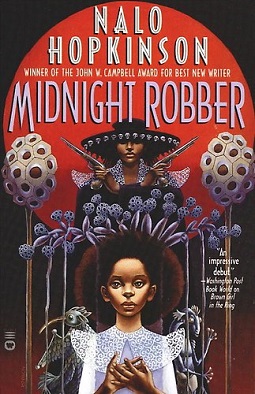
(2000)
It's Carnival time and the Caribbean-colonized planet of Toussaint is celebrating with music, dance, and pageantry. Masked "Midnight Robbers" waylay revelers with brandished weapons and spellbinding words. To young Tan-Tan, the Robber Queen is simply a favorite costume to wear at the festival-until her power-corrupted father commits an unforgiveable crime.
Suddenly, both father and daughter are thrust into the brutal world of New Half-Way Tree. Here monstrous creatures from folklore are real, and the humans are violent outcasts in the wilds. Tan-Tan must reach into the heart of myth and become the Robber Queen herself. For only the Robber Queen's legendary powers can save her life . . . and set her free.
Suddenly, both father and daughter are thrust into the brutal world of New Half-Way Tree. Here monstrous creatures from folklore are real, and the humans are violent outcasts in the wilds. Tan-Tan must reach into the heart of myth and become the Robber Queen herself. For only the Robber Queen's legendary powers can save her life . . . and set her free.

2003
When three Caribbean slave women, led by dignified doctress Mer, assemble to bury a stillborn baby on the island of Saint Domingue (just before it is renamed Haiti in 1804), Ezili, the Afro-Caribbean goddess of love and sex, is called up by their prayers and lamentations. Drawing from the deceased infant's "unused vitality," Ezili inhabits the bodies of a number of women who, despite their remoteness from each other in time and space, are bound to each other by salt-be it the salt of tears or the salt that baptized slaves into an alien religion. The goddess's most frequent vehicle is Jeanne Duval, a 19th-century mulatto French entertainer who has a long-running affair with bohemian poet Charles Baudelaire. There is also fourth-century Nubian prostitute Meritet, who leaves a house of ill repute to follow a horde of sailors, but finds religion and a call to sainthood. Meanwhile, the seed of revolution is planted in Saint Domingue as the slaves hatch a plan to bring down their white masters. Ezili yearns to break free from Jeanne's body to act elsewhere, but can do so only when Jeanne, now infected with syphilis, is deep in dreams. Fearing that she will disappear when death finally calls Jeanne, Ezili is drawn into the body of Mer at a cataclysmic moment and is just as quickly tossed back into other narratives.

(2007)
First it's her mother's missing gold brooch. Then, a blue and white dish she hasn't seen in years. Followed by an entire grove of cashew trees.
When objects begin appearing out of nowhere, Calamity knows that the special gift she has not felt since childhood has returned-her ability to find lost things. Calamity, a woman as contrary as the tides around her Caribbean island home, is confronting two of life's biggest dramas. First is the death of her father, who raised her alone until a pregnant Calamity rejected him when she was sixteen years old. The second drama: she's starting menopause. Now when she has a hot flash and feels a tingling in her hands, she knows it's a lost object calling to her.
Then she finds something unexpected: a four-year-old boy washes up on the shore, his dreadlocked hair matted with shells. Calamity decides to take the orphaned child into her care, which brings unexpected upheaval into her life and further strains her relationship with her adult daughter. Fostering this child will force her to confront all the memories of her own childhood-and the disappearance of her mother so many years before.
When objects begin appearing out of nowhere, Calamity knows that the special gift she has not felt since childhood has returned-her ability to find lost things. Calamity, a woman as contrary as the tides around her Caribbean island home, is confronting two of life's biggest dramas. First is the death of her father, who raised her alone until a pregnant Calamity rejected him when she was sixteen years old. The second drama: she's starting menopause. Now when she has a hot flash and feels a tingling in her hands, she knows it's a lost object calling to her.
Then she finds something unexpected: a four-year-old boy washes up on the shore, his dreadlocked hair matted with shells. Calamity decides to take the orphaned child into her care, which brings unexpected upheaval into her life and further strains her relationship with her adult daughter. Fostering this child will force her to confront all the memories of her own childhood-and the disappearance of her mother so many years before.
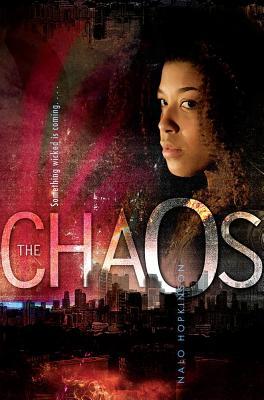
The Chaos
2012
Sixteen-year-old Scotch struggles to fit in—at home she’s the perfect daughter, at school she’s provocatively sassy, and thanks to her mixed heritage, she doesn’t feel she belongs with the Caribbeans, whites, or blacks. And even more troubling, lately her skin is becoming covered in a sticky black substance that can’t be removed. While trying to cope with this creepiness, she goes out with her brother—and he disappears. A mysterious bubble of light just swallows him up, and Scotch has no idea how to find him. Soon, the Chaos that has claimed her brother affects the city at large, until it seems like everyone is turning into crazy creatures. Scotch needs to get to the bottom of this supernatural situation ASAP before the Chaos consumes everything she’s ever known—and she knows that the black shadowy entity that’s begun trailing her every move is probably not going to help.
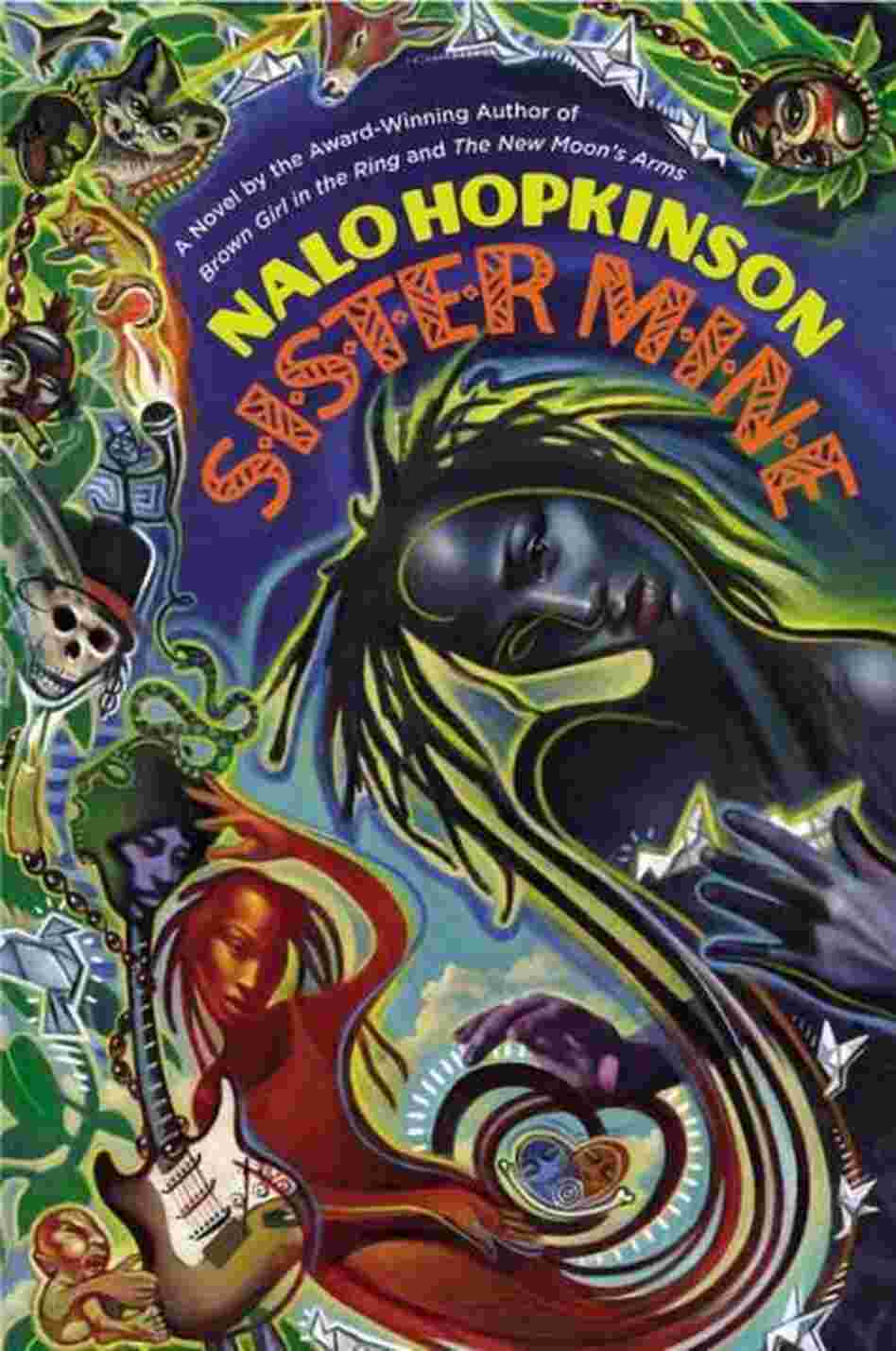
Sister Mine
2013
Now adults, Makeda and Abby still share their childhood home. The surgery to separate the two girls gave Abby a permanent limp, but left Makeda with what feels like an even worse deformity: no mojo. The daughters of a celestial demigod and a human woman, Makeda and Abby were raised by their magical father, the god of growing things--an unusual childhood that made them extremely close. Ever since Abby's magical talent began to develop, though, in the form of an unearthly singing voice, the sisters have become increasingly distant.
Today, Makeda has decided it's high time to move out and make her own life among the other nonmagical, claypicken humans--after all, she's one of them. In Cheerful Rest, a run-down warehouse, Makeda finds exactly what she's been looking for: a place to get some space from Abby and begin building her own independent life. There's even a resident band, led by the charismatic (and attractive) building superintendent.
But when her father goes missing, Makeda will have to find her own talent--and reconcile with Abby--if she's to have a hope of saving him . . .
Friday, June 7, 2013
Sci-Fi/Fantasy Diversity Quotes

Agreed that some evaluations of bigotry are simply perception. But bigotry also has real, measurable effects. Bigotry in literature has an historical context, and the author’s intentions don’t always trump the real effect that his/her work has had on his readers.
In Tolkien’s case, much of the evidence against bigotry does not exist within the work he’s best known for (LotR); it exists in peripheral or unpublished sources, like the Silmarillon and his personal notes. Judging him on his published fiction alone, it’s hard not to notice that he does the same thing that many fantasy authors before and since have done, which is to reduce the presence of non-white people to “the enemy” or “the other”, and further ascribe to them qualities like “decadent” and “evil” and “easily duped”. Not altogether different from the way people of non-European cultures have been described by racists for several hundred years.
And further, Tolkien’s influence on the fantasy genre is part of the reason why it’s so heavily focused on medieval (especially northern) Europe and pseudo-medieval Europe; his legacy is not just his own work, but also a generation of Tolkien clones, Tolkien-inspired D&D games full of racial essentialism, and publishing gatekeepers who simply assumed that epic fantasy wouldn’t sell if it wasn’t Eurocentric, like Tolkien’s work. All that’s not really his fault; I’m sure he didn’t intend to have that kind of effect. But for the readers of color who try to engage with epic fantasy and run smack into that essentialism, or those stereotypes, or those gatekeepers, the effect is real and lasting.
Subscribe to:
Posts (Atom)